News

All the news about NODES and its innovation ecosystem: projects, partners, announcements, and events.

News
 - 
3. Culture and tourism industry
Nodes Challenges: Uninsubria students visit Novello Case
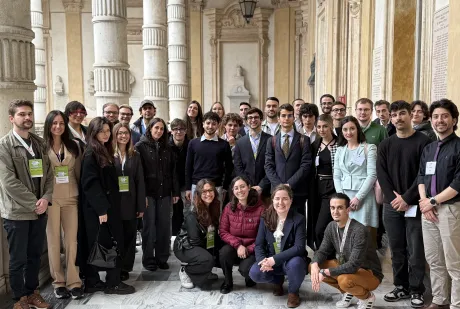
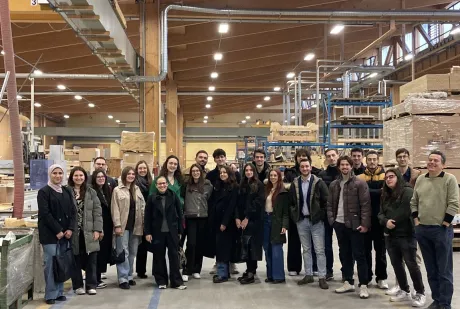
  In recent days, a group of students from the IBE and FIMIF-FIMEDIS Master's Degree courses in Economics at the University of Insubria had the opportunity to visit the company Novello Case srl in Oggiona con Santo Stefano (VA) as part of the Challenges of the Nodes project.   The aim of the visit was to experiment with collaboration between students from Master's Degree courses characterized by different educational objectives, offering them the opportunity to interact with local business realities and work together on topics of innovation and sustainability.   The contamination of ideas between students with different backgrounds, and between the academic world and business are essential to enhance the talent of young people.
News
 - 
3. Culture and tourism industry
Northwest businesses take part in the Roadshow "Tourism and culture: innovation for the Northwest"
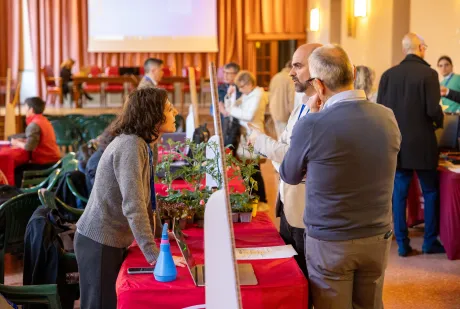
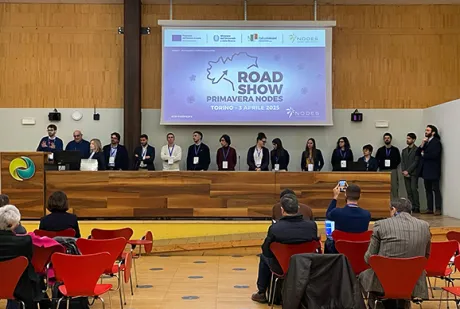
On March 31, 2025, the event "Tourism and culture: innovation for the North West" was held at the University of Turin, a partner of Spoke 3 - Tourism Industry and Culture, organized as part of the Primavera Nodes Roadshow initiative.   During the event, several companies operating in the North West took part and were able to win funds from the cascade calls.   Thanks to the funds received, companies were able to start interesting industrial research and experimental development projects that were presented during the day. Prototypes of applications to be used in the field of tourism, culture but also sustainable fashion captured the attention of those present, who asked several questions to the company representatives.   Finally, Prof. Piercarlo Rossi of the University of Turin and Prof. Stefania Cerutti of the University of Eastern Piedmont presented the results obtained to date with the two flagship projects CIRIL and TOEP.    
News
 - 
6. Primary agroindustry
Clone of Renewable Energy Communities in Agricultural Areas: Interview with NODES PhD Candidate Oriana Benfatto
Oriana Benfatto, a third-year PhD candidate within the NODES program in the PhD course in Electronic, Computer, and Electrical Engineering (Cycle 38), talks to us about her research project, "Sustainable services for agricultural areas: renewable energy communities and micro-grids." The project, supervised by Professor Norma Anglani from the Department of Industrial and Information Engineering at the University of Pavia, is developed within the flagship project FORMIDABILAE. It focuses on integrating renewable energy and energy communities to enhance sustainability in agricultural areas. NB: Renewable energy communities represent an opportunity to make the agricultural sector more sustainable and efficient. In your opinion, what are the main obstacles to their large-scale adoption? OB: Energy communities offer a great opportunity to make agriculture more sustainable, but they also face several challenges. One of the main issues is the stability of the electrical grid: while renewables are essential, they are also variable, requiring storage systems and advanced strategies. Moreover, a lack of awareness among farmers and citizens limits participation, highlighting the need for greater outreach and education. Bureaucratic complexity also slows development, with intricate procedures and uncertainties regarding incentives. Overcoming these challenges requires clearer regulations, targeted incentives, and advanced energy storage and smart management technologies to ensure a sustainable and inclusive transition. *** NB: The FORMIDABILAE project aims to develop innovative solutions to improve energy efficiency in the agri-food sector. What is the specific contribution of your research in this context, and what promising technologies are you working on? OB: Within the FORMIDABILAE project, my research focuses on a case study involving a dairy farm, evaluating electrical loads and converters to make it as self-sufficient as possible and less dependent on the power grid. Specifically, I study the control of grid-forming and grid-following inverters to ensure system stability while optimizing energy flow between renewable sources, battery storage, and critical loads such as milking and milk cooling systems. In parallel, we analyze municipalities served by the same primary substation, assessing the potential for rooftop photovoltaic installations using geospatial analysis techniques and comparing estimated energy production with consumption data from national databases. This allows us to estimate the community's self-sufficiency level and optimize system sizing. The ultimate goal is to develop a replicable model for creating self-sufficient energy communities, promoting the adoption of advanced energy efficiency technologies and renewable energy integration in the agri-food sector. *** NB: Being part of the NODES ecosystem and a flagship project like FORMIDABILAE, has this experience provided you with new perspectives or collaborations that have enriched your research journey? What results have you achieved so far? OB: Being involved in the NODES project has allowed me to collaborate with the AUDE laboratory at the University of Pavia, fostering interdisciplinary dialogue. This experience has enriched my journey, enabling me to analyze energy communities from technical, architectural, and urban planning perspectives. I have visited research centers and agri-food companies, gaining firsthand insight into renewable energy technologies and practical challenges. I developed a simulation model to assess the energy self-sufficiency of a dairy farm and its connected community, combining load analysis with photovoltaic potential evaluation.Additionally, I have deepened my study of grid-forming and grid-following inverter control to enhance local grid stability, proposing scalable solutions for the agri-food sector.
News
 - 
5. Industry for health and Silver Economy
4th Stakeholder Committee - Spoke 5
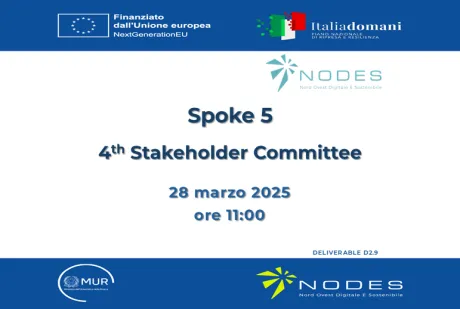
On March 28th, 2025, the Stakeholder Committee of Spoke 5 met virtually to take stock of the progress of the spoke. Here the main points discussed:    Spoke 5 and the objectives of the Stakeholder Committee:  The project manager of Spoke 5, prof. Marco Invernizzi, introduced the NODES project, highlighting the key role of the Stakeholder Committee in defining the objectives and goals of the project, as well as supporting strategic decisions and scientific collaborations.    Flagship Projects: The progress of the flagship projects INNDIANA and TINCARE were presented, in line with the project's timeline and with significant results in terms of scientific publications, studies approved by the Ethics Committee and patent development.   Proof of Concept:  Particular attention was given to the PoCs, both academic and industrial. The high demand for funding exceeded available resources, confirming the strong interest in the themes of Spoke 5. The vast majority of the projects are still ongoing, also in base of the extension requests that were received and approved by the Evaluation Committee. All the projects (both Academic and Inudstrial PoC) financed in the first and second cut-off have successfully passed the mid-term review, both from an administrative, accounting and scientific perspective.    Roadmap: Dr. Anrò of the bioPmed innovation cluster showed the update of the Roadmap, in line with NODES timeline. After an initial draft developed in M3, based on the Intelligent Specialization Strategy (S3) of the Piedmont Region, a final version was launched in  M18 thorugh an online survey aimed addressed to companies.  Now, in M30, the Roadmap is being updated based on the results obtained from the flagship projects and both academic and industrial PoCs, with the aim of integrating new evidence and guiding the next strategic actions.    Events 2025:  In 2025, several events are planned to promote the results of the NODES project:  April: business event for the presentation of projects and first results. (14 aprile 2025 - Vercelli) May: meeting on Academic PoC, with the aim of attracting potential investors. September: participation in the European Researchers' Night. End of the year: HUB NODES concluding events, focusing on the project’s closure and future perspectives.     The concluding discussion highlighted the participants' support for Spoke 5 acivities, confirming their continued interest in NODES initiatives and their future prospects. 
News
 - 
7. Secondary agroindustry
Companies present innovation projects in the Agrifood sector
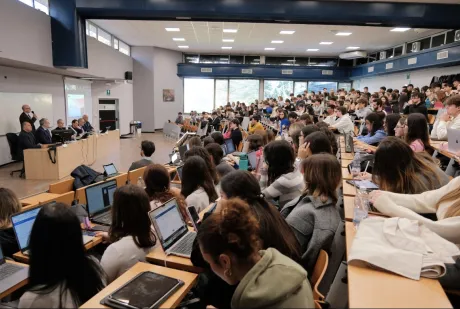
The University of Turin hosts the event dedicated to the theme of innovation  New products starting from valorized by-products, new processes for the control of food quality and food safety, digital technologies at the service of food transformation and supply chain control, environmental and social sustainability, circularity...   The event, linked to the NODES Spring Roadshow, took place in the Aula Magna of the University of Turin on March 25 and was attended by approximately 60 people including companies, stakeholders, researchers from the Turin area. North-West.   These are the themes of the stage hosted by the University of Turin and dedicated to the  enterprises of Spoke 7 - Secondary Agro-industry to present the results of innovation projects! The perfect opportunity to show the enthusiasm of many companies and startups in experimenting with innovative solutions!
News
 - 
4. Digital innovation toward sustainable mountain
Spoke 4 projects presentations are ready!
The "Networking and Acceleration on the Digital and Sustainable Mountain" meeting, held on January 16 at the LINKS Foundation headquarters, was an important moment of progress for NODES Spoke 4. This is demonstrated by the data, such as: 68 registered attendees 22 participating companies and startups 8 meetings between companies/startups and investors 25 B2B meetings between companies/startups At this page, the projects shown at the event are ready to be shown!
News
 - 
HubNodes
NODES protagonista al Roadshow MICS: manifattura additiva e sostenibilità al centro del confronto tra imprese, ricerca e istituzioni
The Innovation Ecosystem Will Speak in the Panel on Initiatives for the Sustainable Transition   The NODES – North-West Digital and Sustainable Innovation Ecosystem confirms its active presence at major events dedicated to the country’s industrial transformation by taking part in the Turin stop of the MICS Roadshow – Made in Italy Circular and Sustainable, scheduled for 26 March 2025 at the Unione Industriali Conference Center in Turin.   During the event — which will bring together representatives from academia, public institutions, and industry — Chiara Ferroni, General Director of NODES, will give voice to the Ecosystem in Panel 3: “World, Europe, Territories: initiatives for sustainability.” She will highlight the concrete actions underway to support the Twin Transition across Italy’s North-West.   MICS and NODES: two pillars of the NRRP for a crcular, digital Made in Italy The MICS Roadshow provides an important opportunity for dialogue among the many actors in the production and research system. Its goal is to explore how innovative technologies can become a lever for a Made in Italy that is increasingly competitive, sustainable, and digital.   NODES’ participation in the Roadshow once again underscores the central role the Ecosystem plays in fostering collaboration among research organizations, businesses, and institutions, helping the production supply chains of the North-West navigate the dual digital and sustainable transition.   Through initiatives like this, NODES strengthens its commitment to accompanying entrepreneurs and SMEs as they adopt cutting-edge technologies, promoting innovative solutions and sustainable business models for competitive and responsible growth.   The 26 March event fits squarely within this mission, offering a full day of deep dives into the potential of additive manufacturing and advanced manufacturing to accelerate the transition of industrial processes. Discover the program
News
 - 
3. Culture and tourism industry
Spoke 3 Challenge Students Participate in Geonight 2025
On Friday 4 April from 7:00 pm to 9:00 pm at the Novara Castle there will be an event branded Geonight 2025 entitled: “Landscapes. Reality, impression, symbol”.   Landscape is undoubtedly a key theme of geography, full of meaning and constantly reinvented. It reflects and stimulates dialogue on urgent issues such as climate change, sustainability and our relationship with nature, which are open fields for today's geographies.   The Geonight 2025 event will see the students of the University of Eastern Piedmont of the Challenge PNRR NODES Spoke 3 participate in a guided and animated tour of the exhibition “Landscapes. Reality, impression, symbol”.   It will allow them to move critically and creatively from the world of art to that of cultural and tourism planning, outlining its role as a lever for sustainable development and a common future. This first-hand experience will also allow them to understand the importance of making ancient and historic containers, such as the castle, a living and open heritage.   The visit will be held in collaboration with METS Percorsi d'Arte and its president Dr. Paolo Tacchini.  
News
 - 
3. Culture and tourism industry
Public Funding for SMEs
Throughout the development process of the NODES project, many companies have approached the project, participating in events, training courses, challenges and other initiatives. A significant number of them have also benefited from the funds deriving from the cascade calls, for the development of innovative projects.   Spoke 3 provides, during the last phase of the project, a service that all NODES stakeholders can access, namely a help desk activated to explore opportunities at national and European level that allow companies to continue what they have undertaken in recent years or to realise what they have imagined but not yet implemented.   The help desk will operate in virtual mode, thanks to the collaboration between the Spoke 3 group of the University of Eastern Piedmont, led by Professor Stefania Cerutti, and the company Novareckon SrL, specialized in the programming of European funds.   Office opening hours: 03/24/2025 to 05/30/2025 Registration deadline: 05/23/2025 For information and registrations write to info@novareckon.it
News
 - 
2. Green technologies and sustainable industries
NODES Spring Roadshow: sustainable and innovative textiles in Como
On Wednesday 19 March 2025, the Spoke 2 stop of the NODES Spring Roadshow took place in the evocative setting of the Sant'Abbondio Cloister of Insubria University. A meeting that turned the spotlight on the most advanced innovative solutions for the sustainable textile sector, the focus of GRIP's Research Module 3 (RM3) and the industrial PoCs of Atelier Riforma, VEGEA and TOT within the Spoke 2 funding!
Annoucements
 - 
6. Primary agroindustry
NODES Panel at TerraEnvision Conference: Call for Abstracts Open
In 2025, the NODES project will once again be featured at the TerraEnvision Conference, taking place at the University of Granada (Spain) from 8 to 11 July 2025. The NODES Session NH1: Innovative solutions for increasing resilience to water-related hazards and soil erosion in agricultural areas is coordinated by Valerio Vivaldi and Valentina Vaglia (Department of Earth and Environmental Sciences, University of Pavia) and Chiara Toffanin and Fabio Dell’Acqua (Department of Electrical, Computer and Biomedical Engineering, University of Pavia). This session aims to highlight the crucial role of Nature-Based Solutions (NbS) in mitigating hydrogeological risks in agro-ecosystems. The call for papers welcomes interdisciplinary contributions in the fields of agronomy, geology, engineering, and hydrogeology, with a specific focus on remote and proximal sensing for monitoring NbS in agro-ecosystems, as well as numerical and physical simulations, such as machine learning models, to analyse the effects of NbS and climate change. The objective is to provide practical tools for farmers and policymakers, showcasing how NbS can enhance resilience to hydrogeological hazards in agricultural areas. 🔹 Deadline for abstract submission: 15 April 2025 🔹 Call for Abstracts: terraenvision.eu/call-for-abstracts-2025 For further information, please contact Dr Valentina Vaglia: valentina.vaglia@unipv.it
News
 - 
2. Green technologies and sustainable industries
Spoke 2 Assembly: a new Spoke 2 meeting in Turin
On Wednesday, 18 March 2025, the Spoke Assembly of NODES Spoke 2 took place in Turin. It was an opportunity for all partners, the Spoke 2 team and the RM leaders of the flagship Project GRIP, to meet, catch up and plan together the next steps of the Spoke activities in the coming months. A big thank you to everyone who participated!
News
 - 
6. Primary agroindustry
Renewable Energy Communities in Agricultural Areas: Interview with NODES PhD Candidate Oriana Benfatto
Oriana Benfatto, a third-year PhD candidate within the NODES program in the PhD course in Electronic, Computer, and Electrical Engineering (Cycle 38), talks to us about her research project, "Sustainable services for agricultural areas: renewable energy communities and micro-grids." The project, supervised by Professor Norma Anglani from the Department of Industrial and Information Engineering at the University of Pavia, is developed within the flagship project FORMIDABILAE. It focuses on integrating renewable energy and energy communities to enhance sustainability in agricultural areas. NB: Renewable energy communities represent an opportunity to make the agricultural sector more sustainable and efficient. In your opinion, what are the main obstacles to their large-scale adoption? OB: Energy communities offer a great opportunity to make agriculture more sustainable, but they also face several challenges. One of the main issues is the stability of the electrical grid: while renewables are essential, they are also variable, requiring storage systems and advanced strategies. Moreover, a lack of awareness among farmers and citizens limits participation, highlighting the need for greater outreach and education. Bureaucratic complexity also slows development, with intricate procedures and uncertainties regarding incentives. Overcoming these challenges requires clearer regulations, targeted incentives, and advanced energy storage and smart management technologies to ensure a sustainable and inclusive transition. *** NB: The FORMIDABILAE project aims to develop innovative solutions to improve energy efficiency in the agri-food sector. What is the specific contribution of your research in this context, and what promising technologies are you working on? OB: Within the FORMIDABILAE project, my research focuses on a case study involving a dairy farm, evaluating electrical loads and converters to make it as self-sufficient as possible and less dependent on the power grid. Specifically, I study the control of grid-forming and grid-following inverters to ensure system stability while optimizing energy flow between renewable sources, battery storage, and critical loads such as milking and milk cooling systems. In parallel, we analyze municipalities served by the same primary substation, assessing the potential for rooftop photovoltaic installations using geospatial analysis techniques and comparing estimated energy production with consumption data from national databases. This allows us to estimate the community's self-sufficiency level and optimize system sizing. The ultimate goal is to develop a replicable model for creating self-sufficient energy communities, promoting the adoption of advanced energy efficiency technologies and renewable energy integration in the agri-food sector. *** NB: Being part of the NODES ecosystem and a flagship project like FORMIDABILAE, has this experience provided you with new perspectives or collaborations that have enriched your research journey? What results have you achieved so far? OB: Being involved in the NODES project has allowed me to collaborate with the AUDE laboratory at the University of Pavia, fostering interdisciplinary dialogue. This experience has enriched my journey, enabling me to analyze energy communities from technical, architectural, and urban planning perspectives. I have visited research centers and agri-food companies, gaining firsthand insight into renewable energy technologies and practical challenges. I developed a simulation model to assess the energy self-sufficiency of a dairy farm and its connected community, combining load analysis with photovoltaic potential evaluation.Additionally, I have deepened my study of grid-forming and grid-following inverter control to enhance local grid stability, proposing scalable solutions for the agri-food sector.
News
 - 
4. Digital innovation toward sustainable mountain
Il CAI Torino e Politecnico di Torino invitano gli studenti a sfidarsi per lo sviluppo di soluzioni innovative per migliorare la sostenibilità e l’efficienza dei rifugi alpini
Nel quadro delle attività formative promosse nell’ambito dell’Ecosistema dell’Innovazione Nord Ovest Digitale e Sostenibile - Spoke 4 - Montagna digitale e sostenibile, il CAI Torino ed il Politecnico di Torino hanno promosso una sfida (Challenge) per gli studenti di ingegneria e architettura chiedendo di proporre e sviluppare soluzioni innovative per i rifugi alpini. All’invito hanno risposto numerosissimi studenti del Politecnico, molti dei quali già con la passione per la montagna ed altri con la forte volontà di avvicinarsi a questa realtà che in Piemonte ci accompagna da sempre con la splendida cerchia di montagne che ci circonda. Oltre 100 studenti hanno risposto alla call e 30 sono stati selezionati per partecipare alla sfida. Il percorso porterà gli studenti, suddivisi in gruppi di lavoro, a proporre soluzioni, metodi e tecnologie per rispondere alle complessità dettate dal contesto specifico dei rifugi alpini in particolare concentrandosi sull’acqua e sull’energia. Questi temi presentano problemi e sfide sia per l’immagazzinamento sia per l’approvvigionamento, anche nello scenario delineato dai cambiamenti climatici, che sono anche più evidenti in alta montagna. La sfida La proposta di soluzioni ingegneristiche innovative per l’immagazzinamento, il trattamento e il riuso dell’acqua e per la produzione e gestione dell’energia per una gestione dei rifugi più efficiente, sostenibile, e resiliente ai cambiamenti climatici. Il percorso Dopo una fase di formazione/informazione in cui docenti del Politecnico di Torino e esperti del CAI Torino hanno illustrato ed inquadrato le tematiche principali, gli studenti suddivisi in gruppi multidisciplinari e con il supporto di mentor qualificati, proporranno idee e soluzioni per la sfida che è stata lanciata. Nel percorso sono, anche, previste uscite didattiche presso un rifugio di bassa quota e un rifugio di alta quota, pensate e strutturate in modo da consentire agli studenti di prendere visione e “toccare con mano” gli aspetti che sono chiamati ad affrontare.  
News
 - 
7. Secondary agroindustry
Innovation Paths in the Cuneo Agri-industry
The Univerisity of Turin in Cuneo hosts an event dedicated to companies in the agrifood sector The conference "Paths of innovation in the agro-industry" was held in Cuneo on March 12. The event was an opportunity to explore the new frontiers of innovation in the agri-food sector, starting from the results of the work of Spoke 7.     After the welcome and institutional greetings, a session of interventions followed on key topics such as: Robotics and agro-industry, with the design of a mobile robot for collecting and analyzing wine samples. Circular economy in the wine sector, with the presentation of a platform to promote sustainable practices. Communicating sustainability in food & drinks, to improve consumer perception At the end of the meeting, a round table offered the opportunity to discuss opportunities for growth and inclusion in the Piedmont agro-industry. During the event, innovative studies were presented, dedicated to biomechanical nanosensors for surface safety, consumer perception of technologies to extend the shelf-life of meat and the use of agri-food by-products, such as the addition of hazelnut and apple extracts in meat burgers and the production of beer with apple waste.